
The fifth pillar
The CFC-Royal Registry Office
We check today for tomorrow's trust.
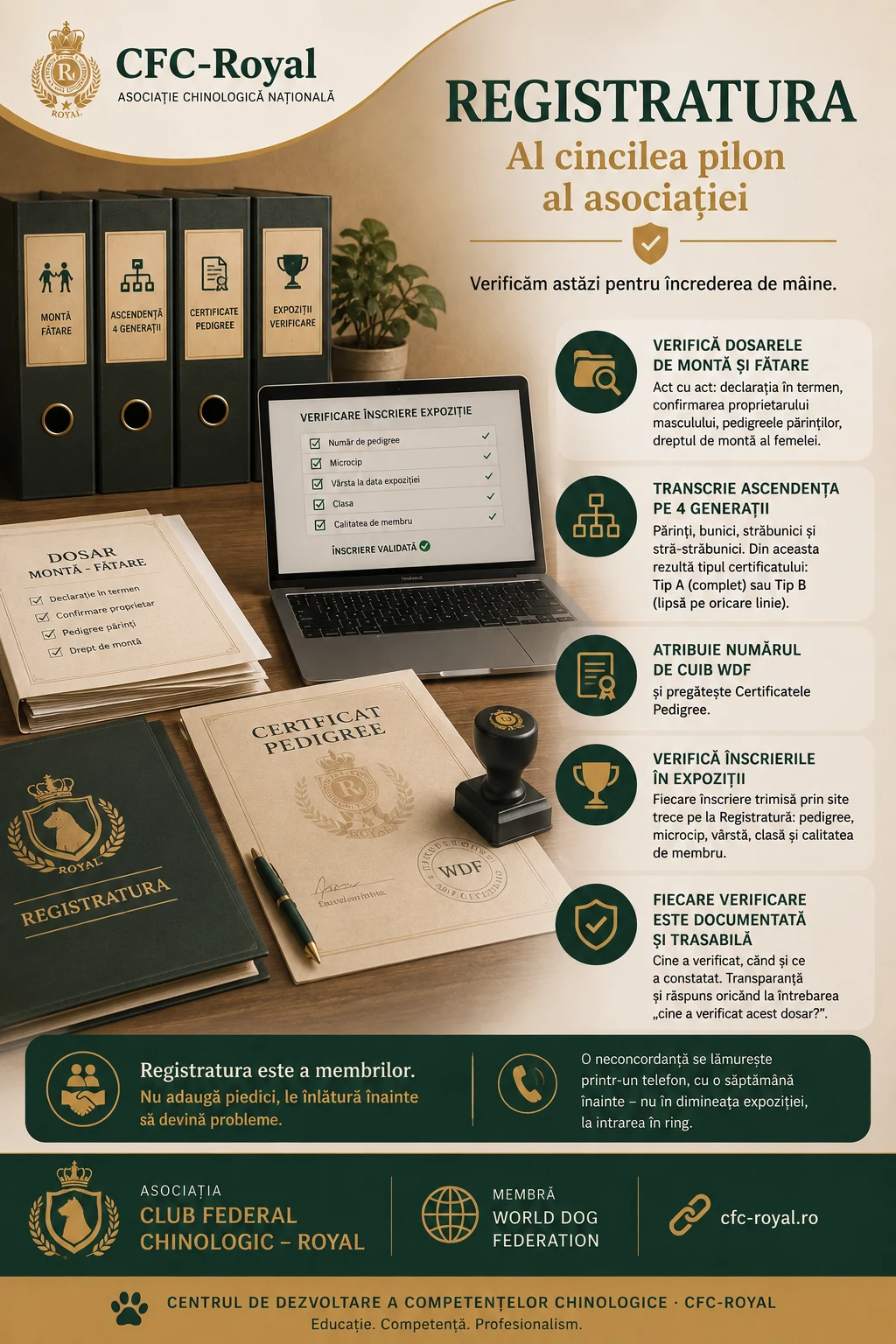
What it actually means
A certificate of origin is worth not the paper it is printed on, but the checking behind it. Who read the mating declaration? Who looked to see whether the dam's pedigree actually exists? Who confirmed that the sire's owner agreed? If those questions have no answer, the document is a nicely printed opinion.
The Registry Office is where the answer exists. Two registrars — the association's president and a second appointed person — go through every file document by document, before it takes effect. Not at the end, as a formality; before, while something can still be put right.
What the Registry Office does
Checks mating and whelping files
Document by document: the declaration filed within the deadline, the sire owner's confirmation, the pedigrees of both parents, the dam's mating entitlement. An incomplete file goes back; it is not approved "with a note".
Transcribes four generations of ancestry
Parents, grandparents, great-grandparents and great-great-grandparents. What is found — and what is missing — determines the type of certificate: Type A, with complete ancestry, or Type B, where a line breaks. Nothing is filled in from memory and nothing is assumed.
Assigns the WDF litter number
And prepares the Pedigree Certificates for issue. Numbers run in sequence, from a counter that cannot give the same number twice.
Checks show entries
Every entry submitted through the site passes through the Registry Office before it reaches the catalogue: pedigree number, microchip, age on show day, the class chosen, membership — and the proof of payment of the entry fee.
Leaves a trace at every check
Who checked, when, and what they found. The question "who checked this file?" has an answer at any time, not only for as long as someone remembers.
How it works, step by step
Two different flows, the same discipline.
For a show entry
- The exhibitor fills in the form on the site and attaches proof of payment.
- The entry joins a waiting list — no one sees it except the registrars.
- The registrar opens the file: documents on one side, payment on the other. Two separate ticks, because they are two separate checks.
- Anything that does not add up is marked "to clarify", with the reason written down. A phone call a week ahead settles what, on show morning, would have become an argument at the ring entrance.
- Only then are the entries imported into the Exhibition Manager, checks and all.
For a mating and whelping file
- The breeder files the declaration in their own space in the stud book.
- The sire's owner confirms the mating — separately, from their own account.
- The Registry Office checks the documents, transcribes the ancestry and determines the certificate type.
- The litter number is assigned and the Pedigree Certificates are issued.
- Every certificate issued can be verified publicly, through the QR code printed on it.
The Registry Office belongs to the members
It does not add obstacles — it removes them before they become problems. A discrepancy settled by a phone call a week ahead never becomes a problem on show morning, at the ring entrance. And a certificate checked before issue is a certificate a puppy buyer can rely on ten years later.
Useful links
Asociația Club Federal Chinologic – Royal · World Dog Federation member